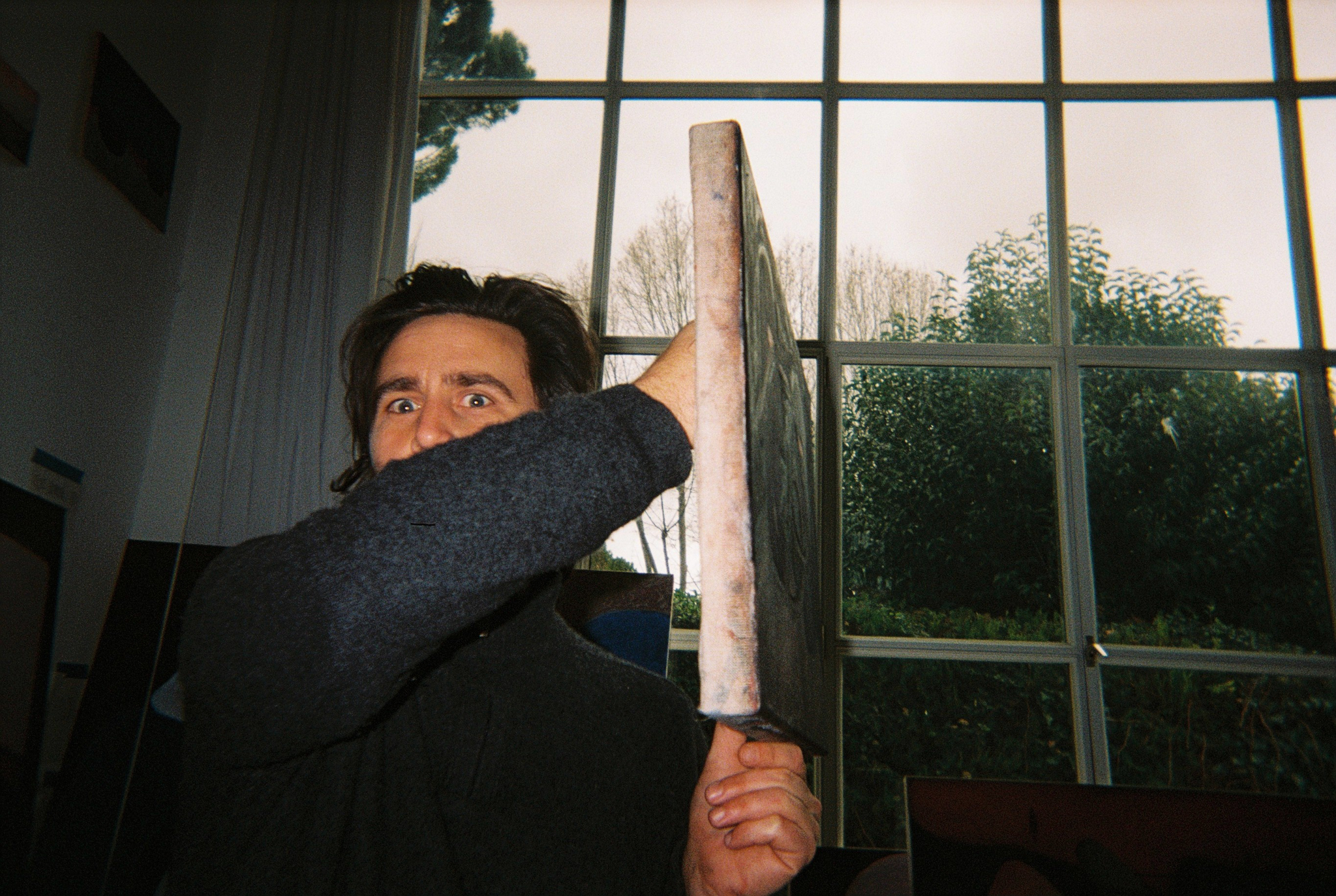
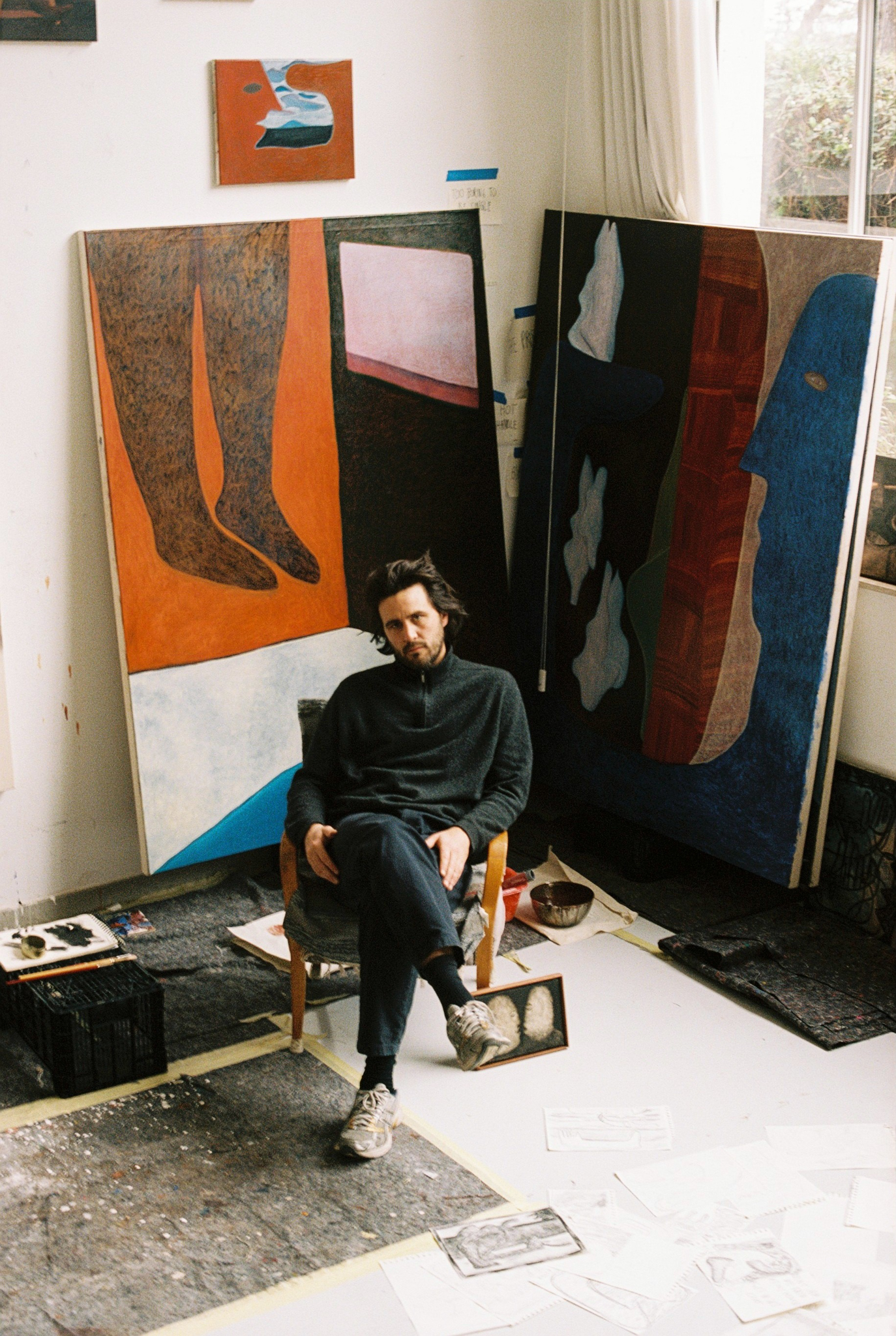
Interview to Diego Kohli (b. 1991), lives and works between Madrid, Spain, y Basel, Switzerland.
Artist Diego Kohli holds my gaze when he replies, and other times looks away, laughing, and seems to try to slip through my questions - a bit like his paintings, which reveal without fully disclosing themselves, in scenes that feel drawn from one of those dreams where you try to open one door, and then another, following a thin thread that leads you through space towards an exit that you sense, but cannot see. And in that anxious search, suddenly a pair of hands appears before your eyes, or a floating foot, or a sausage, or something else completely unexpected - and as you look at it, you find yourself laughing uncontrollably; you burst out laughing without quite knowing why, or whether you are still trapped, or have managed to escape, or what exactly is going on.
All of it set to experimental jazz. And so the interview begins:
Artist Diego Kohli holds my gaze when he replies, and other times looks away, laughing, and seems to try to slip through my questions - a bit like his paintings, which reveal without fully disclosing themselves, in scenes that feel drawn from one of those dreams where you try to open one door, and then another, following a thin thread that leads you through space towards an exit that you sense, but cannot see. And in that anxious search, suddenly a pair of hands appears before your eyes, or a floating foot, or a sausage, or something else completely unexpected - and as you look at it, you find yourself laughing uncontrollably; you burst out laughing without quite knowing why, or whether you are still trapped, or have managed to escape, or what exactly is going on.
All of it set to experimental jazz. And so the interview begins:

I believe it was in 2015 when you traveled through Latin America and decided to dedicate yourself to art. It reminds me of a question that was asked to Francis Bacon in his last interview: were you born an artist? Or rather, how was that process of finding yourself in art?
It’s a good question. I think I’ve always had an intuition toward art. I grew up surrounded by art, even though my parents weren’t artists or anything like that. But there were always paintings at home, always something creative around me.
I remember that I actually hated drawing at school. In Switzerland, where I studied, it was always very academic. When you’re a kid, you have to draw something realistic, and I was terrible at that. I think that’s also where a kind of trauma comes from, thinking: “Damn, I can’t do it. I’m never going to be an artist because I can’t paint a hand, an arm, a foot.”
Later, when I was 18 or 19, I took a trip to Morocco with a friend who was an artist. There, he was always drawing in his sketchbook. So I thought I could try to, but without overthinking it, without planning what I had to do exactly. That’s when that moment of reconnection began: drawing without the idea of doing it well, without trying to be realistic, just whatever I felt like doing, without laws, without rules.
From then on, after that trip, I kept on drawing. I entered an art school very late. I started when I was 24 or 25, because before that I worked to earn money. Then I applied, got in, and from that moment on I never stopped. Now I’m 34, I’ve been working for about ten years.Yes, that’s more or less how I started, I think.
So, would you say you found in art a way to escape from a very structured environment?
Partly yes, but I should also say that I grew up in a pretty creative environment. Graffiti was very common in our circle of friends, for example. I didn’t do it myself, but it has always fascinated me. I took photos of people, I was around what was going on; I loved that whole moment of adrenaline, the group, creating something together.
That’s also when I realized that there are different ways of making art. I think a lot comes from there. For me, my friends have been a very important inspiration. In the end, I think that’s it: my friends inspired me to make art.
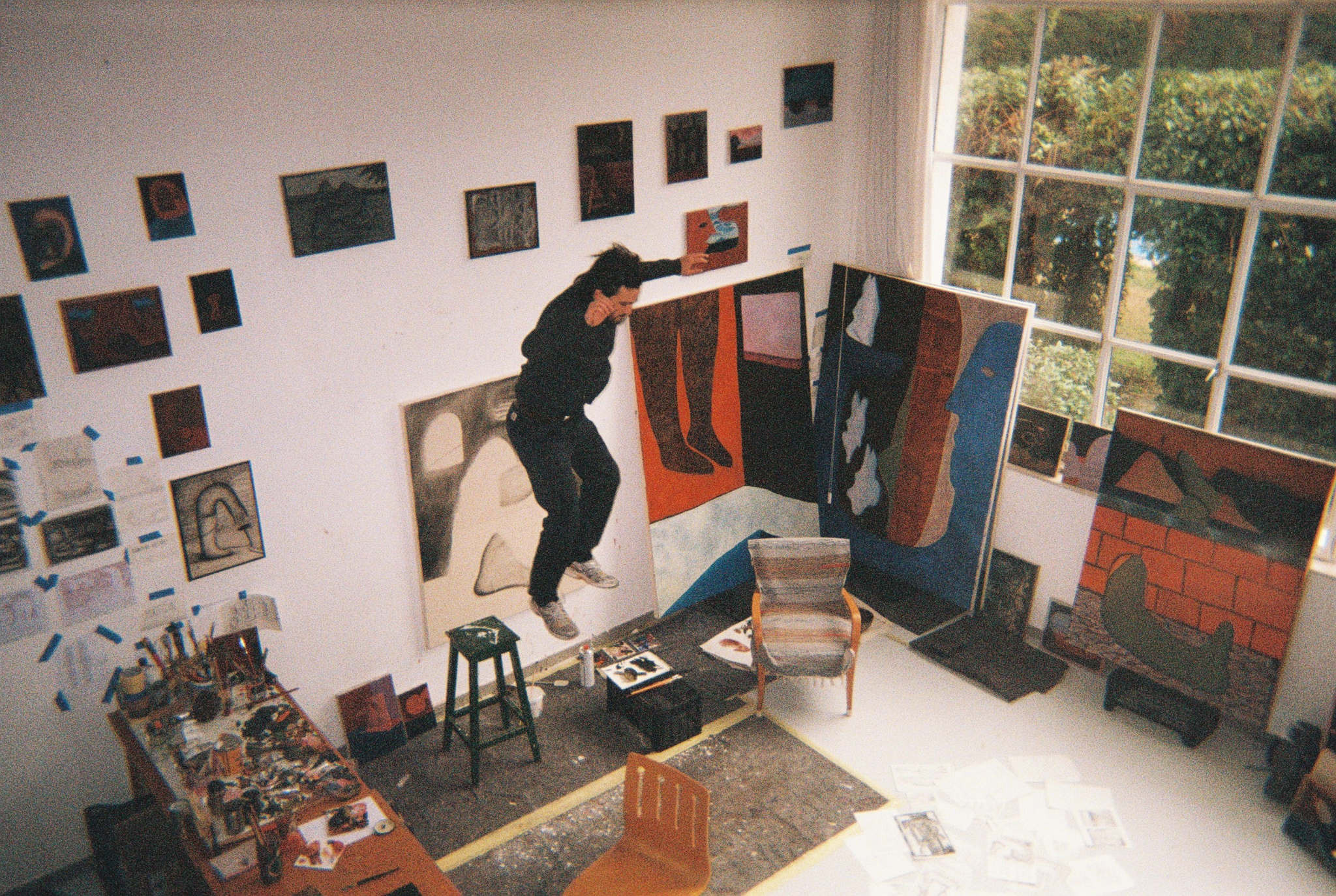
In your personal statement you say your work is “the highest form”. I get the feeling you’re talking about something almost mystical in painting, as if it elevates you or takes you beyond.
I think the highest form can be interpreted in different ways. It can also mean reaching a delirium, a moment when you forget everything, even yourself. And for me, that’s painting. It’s that real connection when you lose yourself in your own work.
The same happens with musicians: when you watch a concert and look at them, you think they’re out of their minds. And when you can access that point, when you reach that state in a practice - whether drawing, painting, or music - it’s the most beautiful point, because it’s very hard to achieve. It’s like a trance.
At the same time, the practice also means the practical side, the material. For me, the material is very important, because I think sensitivity is everything: the texture of the canvas, how you paint, the techniques, how you apply the material, how you can constantly innovate. Not thinking “this is fine,” but always taking one step further, reflecting on how to do it differently.
In that line, I also remember a series I did, the Home Story Series. They’re black-and-white paintings, but they also contain color. I was working with the idea of charcoal on paper and asking myself how I could achieve that same effect with oil on canvas. That was an exploration that lasted years, because charcoal has a very beautiful texture, but it doesn’t stay on the canvas. You can fix it, but there’s always an issue.
In the end I found a solution, but I’m not going to tell it. [Laughs]. The only thing I’ll say is this: use good-quality oil paints.

You’ve also written that you don’t consider yourself an artist but a painter. Could you explain that difference?
I think I’m not capable of doing anything other than painting. Yes, a painter is an artist, but it’s more specific. Today I have a bit of an issue with this, because I see people saying: “I’m a photographer, I’m a designer”, etc. In the end you think: do they really know what that word means? It requires a lot of time, effort, and personal work.
I am a painter. It took me years to say it. Truly. To say: yes, I am a painter. Because it means constantly making mistakes, and working, working, working. It’s a very strong word for me.
I think the difference is that I wouldn’t be capable of doing a performance, for example. It’s not my personality. I am a painter. I can’t say anything else. I can consider myself an artist in some way, yes, but if you ask me what I am, I always say the same: I am a painter.
Do you think that has something to do with the more artisanal or tangible side of painting?
One hundred percent. I think technique is something people are forgetting today, whereas it is historically very important. You can express yourself, emotions, ideas, but you’ll always reach a point where you hit a limit. Technique is like cooking: you can have ideas, but if you lack skills, you don’t go as far.
And I’m not saying that if you don’t know how to you shouldn’t paint - that’s not it. I think it is a process, and the most important thing is not being afraid, and constantly stepping out of your comfort zone. Exploring is the most beautiful thing about painting.
An artwork is never really finished. There’s always something more. The moment of saying “it’s finished” is very difficult. There are few paintings of which I can really say: it’s finished. For me, each one leads you to another one.
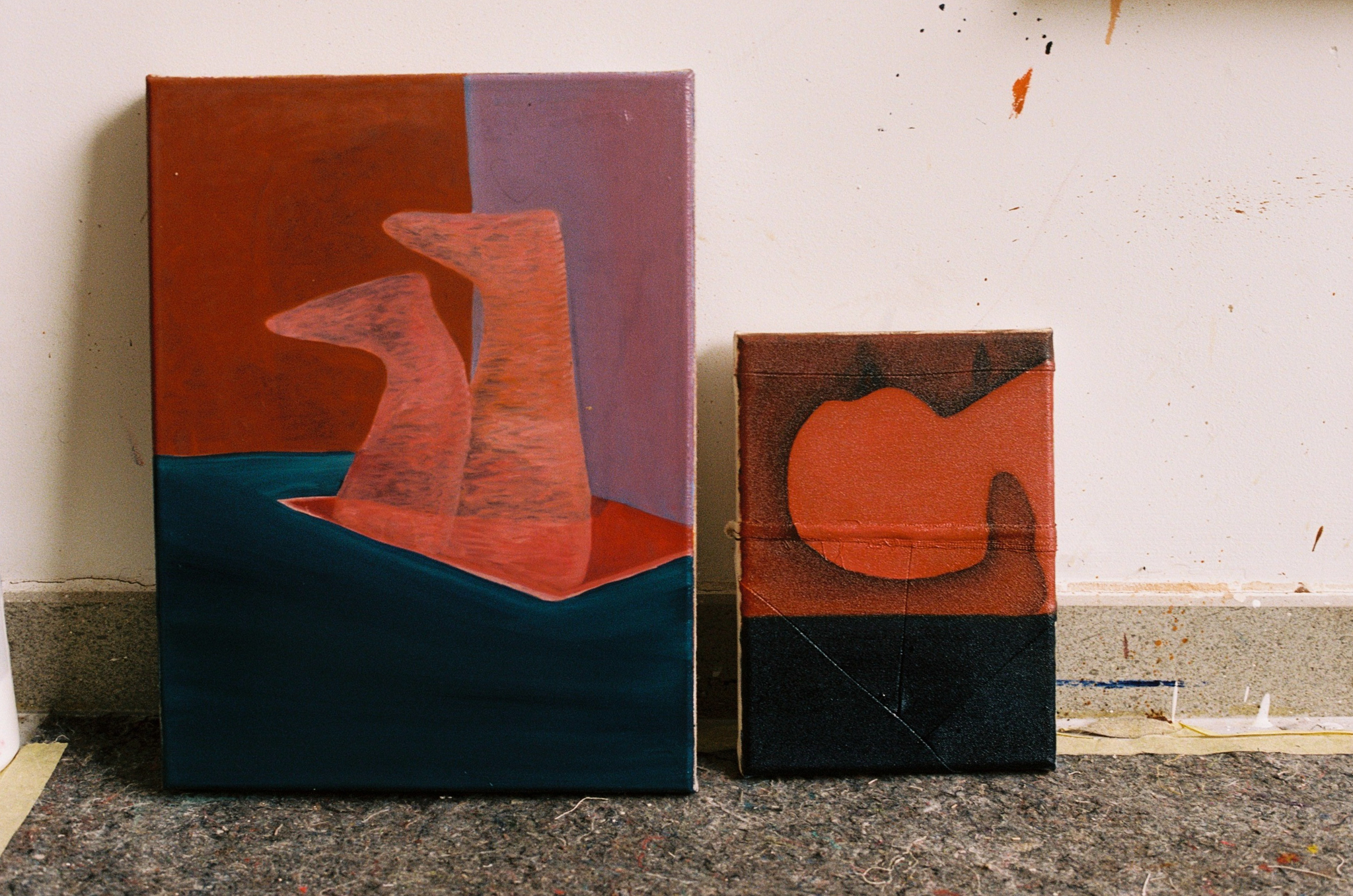
Small formats are where I explore. Everything I investigate on a small scale I later bring into large one. In small ones I’m much freer, because I don’t think as much as with a big one. It’s like a playground, a place to play. It’s a sketch, but at the same time it isn’t. The sketch is the most beautiful thing, because it’s the first idea, made without overthinking. It’s something intrinsic, that comes from inside.

Along those lines, you’ve mentioned that you make your own canvases and paints. Is that material dimension important to you?
Yes, yes, yes. I really like that. I like the tangible, the tactile; feeling and understanding the material, the texture, how it works. In the end it may seem silly, but it’s like going to the supermarket and seeing ten different types of rice. Why are there ten? Because each one has its thing. With fabrics it’s the same: each canvas has its character, and you explore depending on what you want to do.
Understanding how the material works is very important for artists. I’m speaking for myself, of course, but in my work it’s fundamental. I couldn’t do this technique on a prefabricated canvas - it’s impossible, for many reasons. One of them is that I hate white. I can’t paint on a white canvas. I like the canvas to be raw, and that influences the drawing a lot. It’s the same with paper. For example, a slightly burnt, warmer white interests me much more. I work with different tonalities. They’re small things, but they change everything. That fascinates me.
I also love recycling things. I use tiles I find to make my palette, I place them on the floor so I know exactly what colors I have. I also mix my own painting mediums. I don’t paint with just one, as many people do, but I make a classical mixture: damar, turpentine, linseed oil. That allows me to play much more with the paint, make it more oily, achieve textures I couldn’t with turpentine alone. To appropriate the material. And it also shows a lot in the color quality. If you buy cheap oil paint, it has a lot of oil and little pigment. A good-quality color, on the other hand, has a lot of pigment and little oil, and the color is much more intense. A good orange, for example, you can really notice. Color, in general, is very important to me.

In your personal statement you also say you like to capture your “daily surroundings”. I’m curious about the part of yourself you project in that observation of the everyday.
I see you’re starting to get personal… [Laughs]
I’ll be honest with you. I think it’s beautiful to talk about how one feels. Many times, in painting, we’re very enclosed in ourselves, because we have the painting, ourselves, and nothing else. There’s something very personal in my work, but it’s hard for me to explain.
For many artists, it’s the question we’re always asked: “Can you explain your paintings?” And many times I think: I don’t feel like explaining them. Do you know why? Because the beautiful thing is letting the other person imagine something.
It’s like reading a book: you and I will never have the same story in our heads, because your imagination and mine are completely different, we have different pasts. In painting it’s the same. Let the painting communicate something to you.
Of course there are things that have happened in my life, hard things, that are in my work. People who know me know that, but I don’t need to explain everything. The spaces I paint are closed spaces, forms that are trapped, that can’t get out. There’s always a sense of confinement, of fear. It’s there. What more can be said?
In that sense, do you think art is also somehow therapeutic?
Yes, there’s a therapeutic aspect, clearly.
For me, what’s therapeutic is the silence painting gives me. Because nowadays human beings are rarely able to live with silence. It causes a lot of anxiety. It’s something that fascinates me, because silence takes you to other places, lets you think in other spheres… Although it’s uncomfortable too, because it confronts you with yourself. It throws things back at you that make you say, “How did this happen?”
Through painting I create a world that is pure imagination, but in that world there is also sadness, hard things. And at the same time humor. It’s tricky, because that is very difficult in painting. Many times it can seem pathetic and turn out awful. Humor also has something very intellectual about it, because it’s not simple. Painting something that is comical is very, very difficult.
But yes, if we’re talking about therapy, for me there are two things in painting: dreams and humor.
I actually had a question about humor in your work. Do you see it as a way to soften more tragic themes?
Not exactly. I believe that, as a person, I’m someone who likes to laugh. I believe that if I can generate happiness though painting, even if it is only for a second, a millisecond - if someone can feel happy when seeing my work, laugh, or think of something beautiful - for me that’s already a lot.
I don’t mean I’m making decorative painting or anything like that. No, no, no. For example, titles are very important to me. There are titles like Too Boring to be Single or Wake Me Up When It’s Over. In one of the paintings there’s a sausage in a room. And you think: who is going to paint a sausage in a room? But in the end it says a lot, because there’s something pleasurable there.
You see the image and read Wake Me Up When It’s Over. How many times do we think that when we’re really in deep trouble and say: “I don’t want to be here, wake me up when all this is over?” For me that title takes you to a very personal place we’ve all experienced.

Dreams are another important theme in your work. Do you draw on your own when creating?
I think there are two different ideas of dreams. There’s daydreaming, dreaming during the day, and then there’s the nighttime dream, the one you have whilst sleeping. As a child, I was always daydreaming. At school I’d be sitting looking out the window, imagining things all the time.
Nowadays many people tell me: “Are you here with us right now or are you somewhere else?” And often I’m elsewhere. I’m not in the present world. They tell me that a lot. “You are…” No. It’s not that. It’s that I’m somwhere else. I’m disconnected. Then I reconnect, like Wi-Fi [Laughs].
I’m in reality, but at the same time not. I don’t know. Some people wake up in the morning and write down their dreams; I don’t do that. But many times I’m walking around, I see something, and I start imagining. But I don’t know if I’d call it dreaming. Dreaming is something I do all day, all the time. I’m a person who dreams.
So, for you… Is painting a way of investigating reality, or of dreaming a new one?
A completely different reality. Completely. For me the most beautiful thing about painting is imagining another reality and building your own world. And that people, when they see my work, can say, “I’m entering someone else’s world.” A world that is also very emotional, as we were saying before. That’s why it’s often hard for me to show my work, because it’s something very emotive. It’s part of me. It’s me that you see there.
I’m not painting to make something beautiful. That’s not my interest when I paint. The idea is to tell something, something personal. I think every work carries a message.

Earlier you mentioned that sometimes you’re walking down the street and something catches your attention and leads you to imagine. Is there any type of image that attracts you repeatedly?
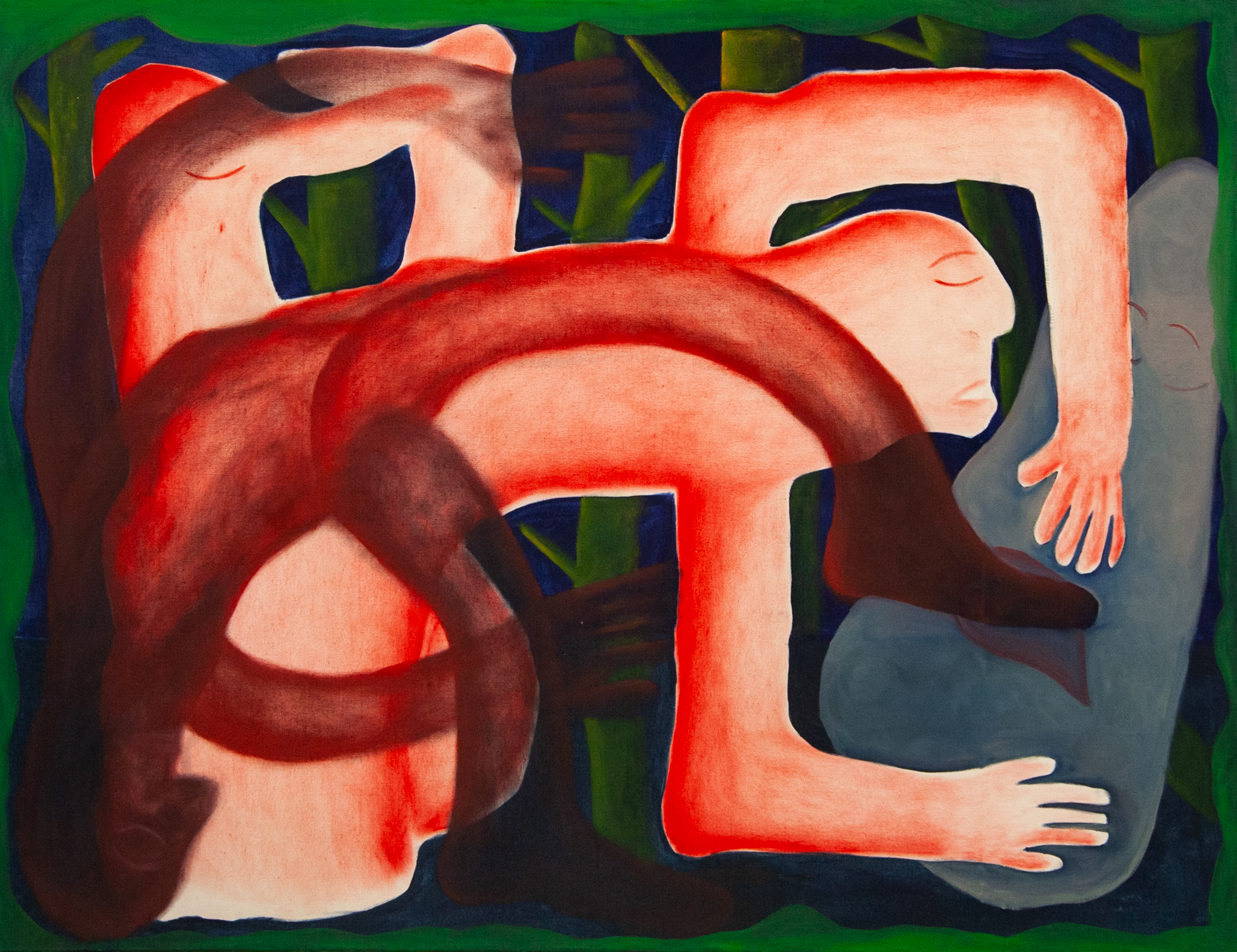
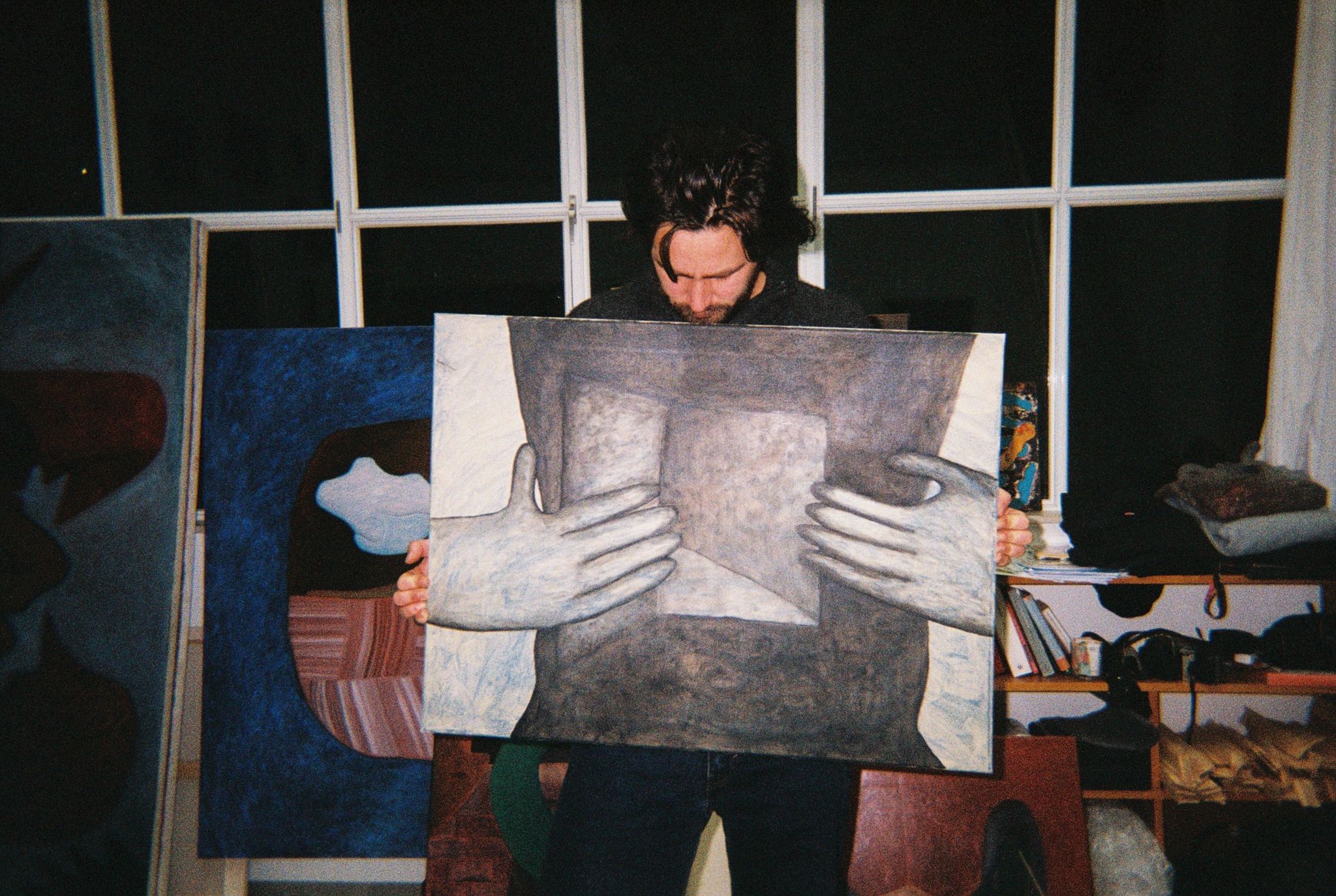
Hands. Hands. Hands. Hands. And feet. There are feet and hands everywhere.
I’ll tell you why: it’s something very personal. I think I have a trauma with hands and feet. Historically they’re the hardest thing to draw. The hardest. I never knew how to do it and I still don’t. [Laughs]
That’s why I think I keep making hands and feet: because I still don’t know how to do them. And that’s why I make these body forms that are put together in strange ways. Sometimes there’s a head but no feet, or the opposite, there are feet but no head, or a hand coming out of a foot. They’re bodies I’m imagining, bodies that aren’t real, that exist only in the mind.
I wouldn’t call it surrealist, not exactly, but it comes from there. The hand and the foot clearly come from that: I’m not capable of drawing a realistic hand or a proportional foot. Impossible. And that’s the beautiful part. That kind of work doesn’t interest me.

And specifically: what do you think feet symbolize in your painting?
It’s a recurring question. People often ask me about hands or feet. But the truth is it’s not something I’ve consciously asked myself.
I think they’re two ways of moving. The foot lets you move, the hand too. But it’s not something I planned from the beginning. It’s not like I say: “I’m going to paint hands because of this, or feet because of that”. Sometimes artists repeat a motif all the time and you wonder why — you don’t know. You do it out of interest, out of necessity. You feel like doing it. Many times it’s only afterward, once it’s done, that you realize why you did it. But while you’re painting, what interests you is seeing the foot or the hand differently. Imagining the human body in another way. In some paintings, for example, they’re almost like still lifes. I’m interested in the idea of still life.
But, hey, now ideas are coming to me, look. Hands mean… they mean strength. Both strength and lack of strength. If you look at them, often they want to grab something, but at the same time they want to let it go. It’s like having something and not knowing if you want it or not. You hold it in your hand, but you almost drop it. Or you’re not able to free yourself from it.
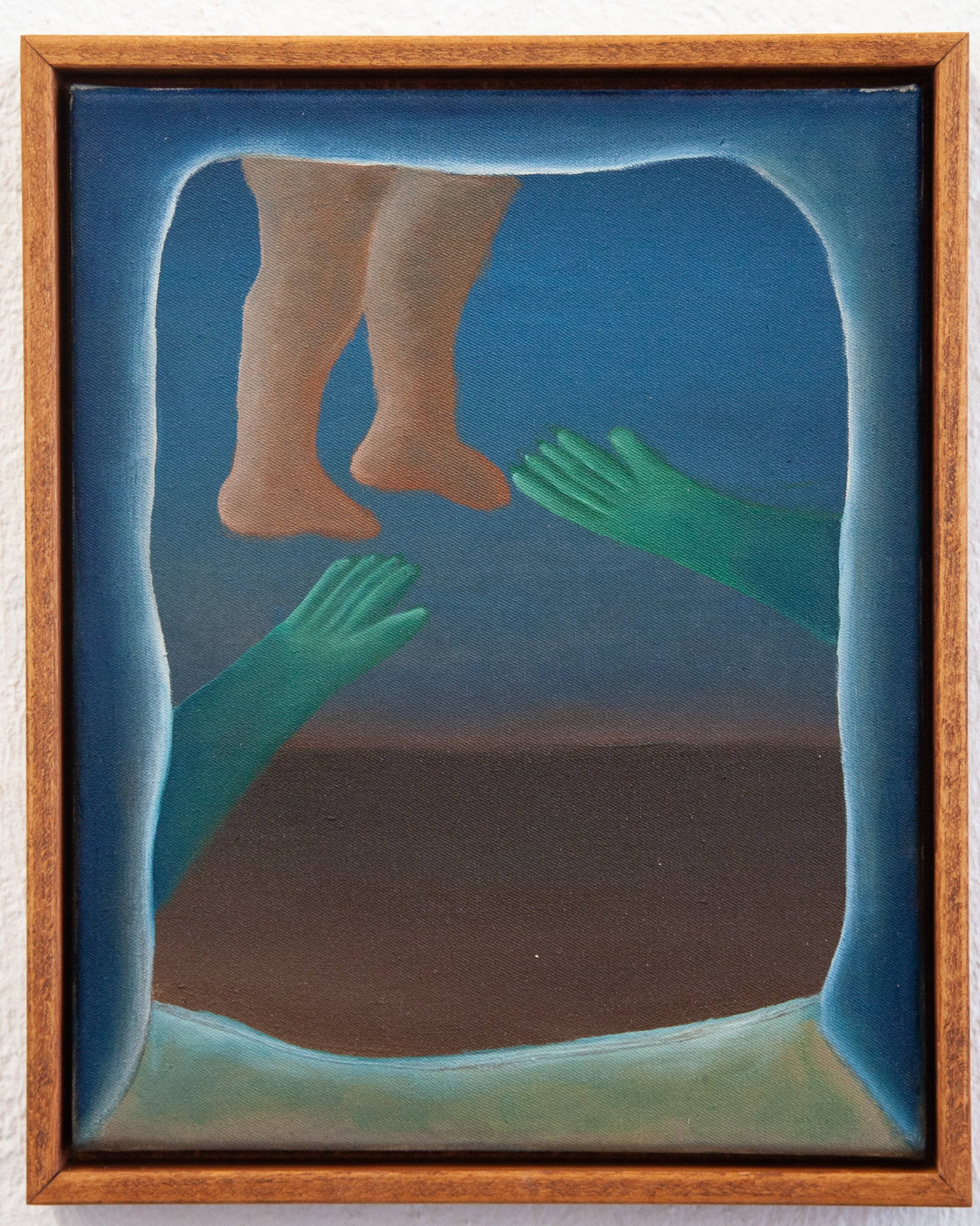
Something similar happens with feet. You don’t know if they’re tied or not, if the thread is strong or weak, if they’re floating or not. Everything revolves around strength and balance, which is something that interests me a lot. For example, in Will I See You Again it’s the same: the feet, the thread - you don’t know if they support or let fall. All that interests me. It’s strength, but not in a physical sense - strength as power.
Something along the lines of desire?
Desire, totally. Yes. Desire is very present. But at the same time the images hide themselves. For example, in that painting up there, you see the feet coming out from behind. In the background there’s the sea, something lyrical, something that makes you think: “I miss the sea.” But the body isn’t there. You only see the feet. What does that mean?
That’s what I love about painting: that moment when you wonder what’s behind, what that unseen head looks like, what’s happening outside the frame. It lets you imagine.
That happens in many works. Like this other one, which still has no title: a foot inside a room. In the end it’s bigger than the room itself. Bigger than the space. And that opens another story.
There’s also something a bit claustrophobic in those spaces you describe, right? Are you interested in conveying that sense of being trapped?
Yes, I think so. I think we’re all trapped at some point in our lives. The idea is to free yourself from that state, from being trapped, to look for a path. That’s why there are always paths in my paintings. There’s always a window, an exit, or someone outside. That imagination of escape always exists.
In the end they’re trapped, but at the same time they’re not. Because there’s always a thread. If you look, for example, at that small still life, you see the thread going toward the right hand, at the bottom. There imagination appears again. Does it hold you or not? Once more, a question of strength.
There are questions you’ve already answered, but there are some topics I’m going to keep pushing you on…
We’ve got a battle of intelligence going on here, right?
You hide a bit… [Laughs]. But this is something I feel you also do in your painting. Your works seem to me like a kind of trompe-l’oeil, almost like theatre. Is there something of that?
One hundred percent.
What does that mean? What are you hiding then?
We don’t know each other that well, I think. [Laughs]
No, but I think something I approach is… Yes, a space beyond. Yes. If you look, there are paintings where it’s quite clear.
I won’t talk more about that. I don’t think it’s necessary. The painting itself does it. I do this, and if people understand it, fine; if not, that’s fine too.

Your style feels very essential, not too realistic, which makes me think almost of cave paintings or of some early 20th-century avant-garde movements that rejected academic models. Do you identify with that?
Totally. Totally. I tried to do the other thing. But I said: that’s not me. That’s not my voice. In the end, the hardest thing for a painter is finding their own voice.
Painting well, technically, can be learned with effort and time. But finding your voice means believing in your path and not letting yourself be constantly influenced. Saying: “this is mine and I’m going this way.” That’s the hardest part.
Of course we all have influences. I’ll never deny mine. Painting is built on history. Everything we learn is history. In my work there are many influences: Edvard Munch, for example; Francisco de Goya, especially in the drawings, but also in the landscapes, in the use of color. There are contemporary painters like Ginny Casey or Martyn Cross, whom I love.
You mentioned Francis Bacon earlier as an influence, but I’m more interested in someone like Philip Guston or Walter Swennen.
I also think about French painters, about dreamlike landscapes - for example Odilon Redon. Many times I’m more inspired by painting from the past than by contemporary work. You go to the Museo del Prado and you see there was already humor there. Hieronymus Bosch, for example… That guy was completely out of his mind. You see his work and think: what world was this person living in to create this? That’s pure imagination. Those, for me, are real artists.
Do you know how many times I’ve been told my work is cryptic or hard to understand? Many. So what? There will always be someone who says that. It’s like coffee: you like it or you don’t. That’s art. I’m not interested in pleasing people. Zero. Art doesn’t have to please. Art has to provoke. If something pleases me too much, it bores me. But if it provokes something I can’t explain, then something is happening. That’s the beauty of painting.
It seems that for you painting is almost like a struggle. Do you paint more from pain or from pleasure?
They’re two extremes, pain and pleasure. I think they go together, as a pair. Pain is something we all have. You and I both have pain. If someone says they don’t, they’re lying. In the end we all have it. Some show it more, others less.
But I think it’s very important, as a human being, to show vulnerability. That’s very important. Even though it’s hard, of course. But I’m looking for the mixture. And the mixture of life contains these two words you mentioned. They’re very present in my work. Very present.

On the other hand, I feel the works oscillate between a figurative language and something more abstract, though not pure abstraction. There’s something about not giving itself easily, not letting itself be understood. Right?
Yes, of course there’s something of that. And that’s where the beauty of collecting comes in. People who collect are people who want to understand you. That’s what’s beautiful about working with collectors: people who fall in love with your work, who have a real interest in your world. I find that very beautiful.
Or curators, for example, who ask you: “So, what do you want to tell us?” Something is being provoked there, and that’s the best thing that can happen.
I’m very interested in the fact that you seem to consider yourself quite a “traditional” painter in contrast to a very diverse art world. How do you feel about that position?
I love it. I love it. I love it. Really. I don’t care. It took me a long time to say it, but I don’t care. I’m happy where I am.
For me, the greatest thing that could happen in my life as a painter is to exhibit in museums. Because in the end that’s where people educate themselves through art. People go to museums for pleasure, but also to learn. And as a painter, being able to show your work in a place like that, for me, that’s the biggest thing there is.
That idea of being outside the world, outside fashion… for me it’s the most beautiful thing. Because being outside fashion is, in fact, being in fashion Why would you want to go with a hundred people doing the same thing? That doesn’t interest me. I want to do my own thing.
I’m not just talking about artists, I mean in general. I like people who really do things for pleasure, not to be accepted, not to fit into society. Not to say: “if I do this they’ll accept me, if I make these cool paintings I’ll do well.” That - zero. I’m talking about myself. Everyone does what they want, but I’m not like that. I’ve always followed my own path. And it’s not easy, of course it isn’t easy. Many times people tell you: “you’re outside everything.” Fine. That’s okay. I enjoy it like this.
If we talk about positions, for me the key word is authenticity. It’s a word that feels important to me. Being authentic, being yourself, being honest with yourself. Not inventing a story that doesn’t exist. I entered art school and saw people inventing discourses: “I’m interested in this, I’ve read this…” I’m not like that. That’s not me. I am this thing I do here. Do you like it or not? I’m not going to change. Really, I won’t. This is my thing, and that’s it.
You’ve mentioned several painters who inspire you, but I don’t know if you have other references, like cinema or literature…
I think music. When I paint, sometimes I love pure silence, but at the same time I adore jazz. Jazz is something I listen to all the time. Especially the more experimental side. Alice Coltrane, Sun Ra, Pharoah Sanders, Yusef Lateef…
It’s music that has something delirious about it, that lets you travel. And I love that. I think music, and especially jazz, gives me rhythm in my work. It lets me travel while I paint.
Reading… I won’t lie, I’m not such a good reader. I have read, but many times it’s hard for me, because in my head, when I read something, I already want to paint. But I think reading is the only way to nourish the imagination without images. It’s the only place where you can create your own images, and that’s the beautiful thing about reading. That’s why I think it’s very important to do it. Reading is the basis for truly working and creating.
Here in the studio I have Märchen von Mördern und Meisterdieben, which translates as “Tales of Murderers and Master Thieves”. They’re short stories with a very surreal content, since they’re fairy tales. In my work I use the book as a source of inspiration to stimulate imagination.

Moving to more general topics. You’ve lived most of your life in Switzerland and you’re half Spanish, half Swiss. From that position, how do you see the emerging art scene in Spain today?
The art scene in Madrid has a lot of potential. Madrid is just beginning. That’s the difference with other places that are already halfway through the process. Here you still feel that beginning.
For example, Paris is unbearable. You can’t afford it. In Madrid it’s starting to happen too, but there are still neighborhoods that really interest me: Usera, Carabanchel, Vallecas… Places where there’s a mixture that many cities have lost - the real neighborhood. Where people live who have nothing to do with art. Madrid still has that. It’s a big city, but at the same time people are relaxed. There’s huge potential. The art scene is interesting too. And in the last ten years, an incredible movement has emerged: new galleries, emerging galleries, new artists.
Another difficulty is VAT. VAT in Spain screws all of us: artist and gallerist alike. For example, I have prices in Switzerland that I can’t have here. And that affects the whole Spanish market. It’s something very real. If that changed, Madrid would explode even more than it already is.
Being an artist in Spain is hard. Very hard. Many jobs pay miserable wages. In Switzerland, for example, you can afford to work 50% and make art. Here you can’t.
I’ve done all kinds of jobs: construction, assistant work, caring for elderly people, waiting tables. The truth of being an artist is having worked other jobs for a long time to finance your own art. That’s the reality. I came here doing jobs I didn’t want to do so I could do this. Cleaning toilets, working for seven euros an hour, serving drinks - like my Spanish artist friends tell me… That’s the reality. And sometimes it’s hard for me to hear interviews where that never appears.
You also mentioned that in Switzerland it’s sustainable to have a part-time job and be an artist, but in Spain that consumes too much energy…
It’s impossible. It doesn’t work. If the minimum salary is around 1,500 euros and you work 50%, and a room costs 700 or 800 euros, how do you do it? The system doesn’t work. It’s blown up. That’s why I always say Switzerland is like Disneyland for an artist. You have security. You work 50%, you don’t live a luxury life, but you can finance your own art. I’ve seen both sides, and I know how artists work here. They work incredibly hard.
That’s why I have a lot of respect for Spanish artists. Really. It’s very tough.
You see it in education too. I studied at the Universitat Politècnica de València. And I’ll tell you something: you can’t put 80 people into a master’s program just for money. Quality drops. It suffers a lot. That’s a real issue in the art scene. If we talk about the scene, we have to talk about education. That’s where everything starts. Education is the most important thing, but it’s barely talked about. That’s where real investment should go.
To start wrapping up, I’d like to ask about your experience as a resident here at Casa de Velázquez.
It’s amazing. I can’t say anything else. It’s incredible to be with other artists, to share, to understand other minds. You’re not alone. You’re in your studio, but then you go to another studio for a coffee, you talk about painting, about someone else’s work. That’s incredible. It feeds me, it nourishes me. Because if you’re alone all the time, you go crazy. Really.
The artist is like a sponge. That’s how we function: we go around absorbing ideas, experiences, images, conversations. When you get to the studio, you squeeze the sponge and the ideas come out.
Ideas don’t come alone. You have to nourish yourself: reading, seeing things, talking, living. Otherwise you can’t say anything. The residency gives you that, and we also have an artistic director, Claude Bussac, who is incredible, because she understands artists. She’s always behind us, supporting, pushing. If you have a problem, they’re there. She lets you work because she trusts the artist’s work.
I was amazed because I applied almost without thinking it would be possible. In the end I passed the preselection, went to Paris, presented the project… I was terrified, honestly. Thirteen people looking at you and you defending your work. But I did the same thing I’m doing today: be honest. Say “this is me.” Not invent a story. And it worked. Sometimes it doesn’t, but this time it did.

Final question…
My dreams?
A classic…
Of course, a classic. You have to finish with something beautiful. I think it’s the hardest question.
My dream… My dream is to be able to keep doing what I do. If life allows me to keep painting, that’s my dream. I don’t have another one. I don’t dream of being an art star or anything like that. It doesn’t interest me. I want to keep doing my work, humbly, with the people I love close to me, and that’s it. The basics: being well, having my people close, sharing good moments with them.
Dreaming too much can also be dangerous. In this world there are many people who promise things that never happen. If you start dreaming about exhibitions, careers, recognition, and then it doesn’t happen, disappointment comes. That hurts. That’s why I stopped projecting so much. If something comes, good. If not, that’s fine. The art world is very volatile. Many people look for attention, acceptance. And that’s dangerous.
That’s why I think what matters is trusting yourself, being okay with yourself. The rest, if it comes, it comes.
Of course there are things you think, “I have a dream, I’d love to have this or that.” We all have them. All of us. And now you’ll ask me: what’s yours?
You trapped yourself. [Laughs]
Yes… Alright. My dream, to finish up this interview, is that when I leave this planet one day, I can say: I did a good job. To be able to say I worked well, that I was a decent person - with my good and bad sides - but that I did something honest.
That’s what I want. That’s my dream. Truly.
Interview by Victoria Álvarez Conde. 25.02.26